

China’s Economic Development and U.S.-China Economic Relations

The U.S.–China relationship is central to the future of the global economy. China’s economic development, trade practices, financial system, industrial policy, development financing, and evolving relationship with the United States are major areas of interest for IIEP faculty, students, and affiliated scholars.
At IIEP, China is an important area of focus for public programming, faculty research, and policy dialogue. Through conferences, events, publications, and related faculty work, IIEP brings together scholars, policymakers, students, and practitioners to examine issues shaping China, the United States, and the global economic system.
Areas of focus. IIEP programming and research related to China have explored topics including economic growth, trade, financial liberalization, industrial policy, labor migration, pension reform, rural-urban development, poverty reduction, gender imbalances, development financing, and U.S.–China economic relations.
GW China Conference. The GW China Conference is IIEP’s signature program focused on China’s economic development and U.S.–China economic relations. The conference brings together leading scholars from the United States, China, and other countries to present research and discuss policy issues critical to China, the United States, and the global economy.
The conference has become one of IIEP’s premier annual convenings, typically featuring a full-day in-person program at the Elliott School of International Affairs as well as related events throughout the year. In 2025, IIEP hosted the 17th GW China Conference in Hong Kong, expanding the conference’s reach and deepening engagement with scholars and practitioners in the region. Learn more about the GW China Conference.
Faculty Research & Public Scholarship. IIEP faculty and affiliated scholars regularly publish articles, op-eds, books, and working papers on China’s economy and U.S.–China economic relations.

December 4, 2026 - 9:00 AM
18th GW China Conference

December 11, 2025 - 9:00 AM
17th GW China Conference
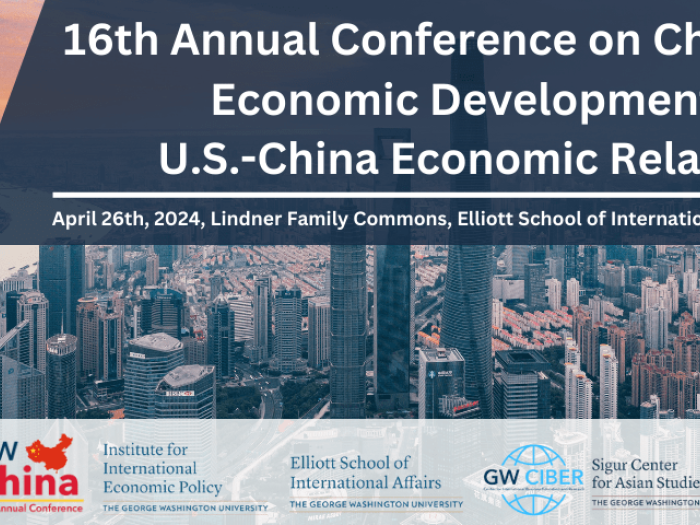
April 26, 2024 - 9:00 AM
16th Annual GW China Conference
April 7, 2023 - 9:00 AM
GWU’s 15th Annual China Conference
December 9, 2022 - 10:30 AM
Overreach: How China Derailed Its Peaceful Rise
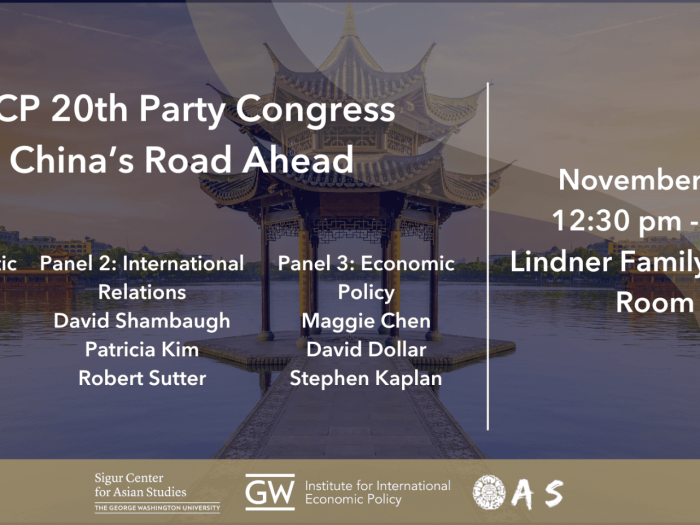
November 4, 2022 - 12:00 PM
The CCP 20th Party Congress and China’s Road Ahead
November 4, 2022 - 12:00 PM
The End of Growth and the Return of Ideology: Economics, Sustainability, and Technology in Xi Jinping’s China
April 22, 2022 - 11:00 AM
China’s Irreconcilable Choices on Ukraine
March 22, 2022 - 4:00 PM
The Avoidable War: The Dangers of a Catastrophic Conflict between the US and Xi Jinping’s China
February 25, 2022 - 9:30 AM
Looking for Balanced Growth in China: Insights from the latest IMF Staff report
November 5, 2021 - 9:30 AM
One Currency, Two Markets: China’s Attempt to Internationalize the Renminbi
October 15, 2021 - 9:30 AM
Did U.S. Politicians Expect the China Shock?